
On September 30, 2026, Flydubai flight FZ1073 was operating from Dubai International Airport to Ben Gurion International Airport in Tel Aviv when a serious incident occurred during the flight.
The aircraft diverted to Tabuk, Saudi Arabia, where it made a safe emergency landing. All passengers and crew were accounted for, although crew members were injured and required medical treatment. The UAE General Civil Aviation Authority (GCAA) described the event as a security incident and said the circumstances were under investigation.
The Flydubai FZ1073 incident has since raised important questions about flight-deck security, crew coordination, emergency response and the way airlines manage an unexpected security threat in flight.
This article separates confirmed information from preliminary findings and reports that remain subject to investigation.
Table of Contents
What Happened on the Flydubai FZ1073 Incident?
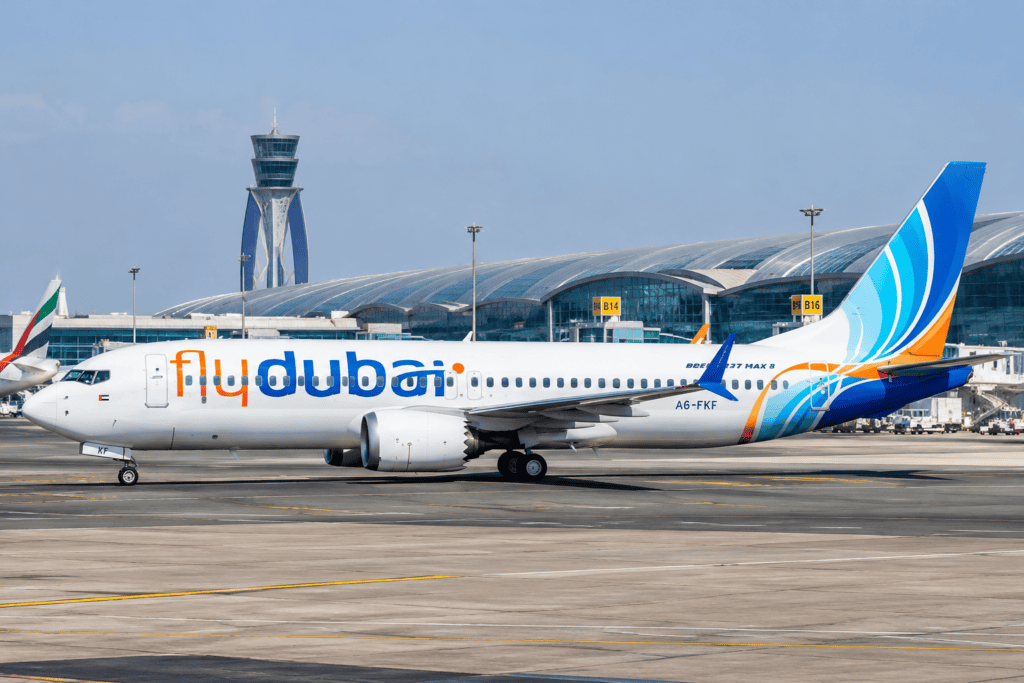
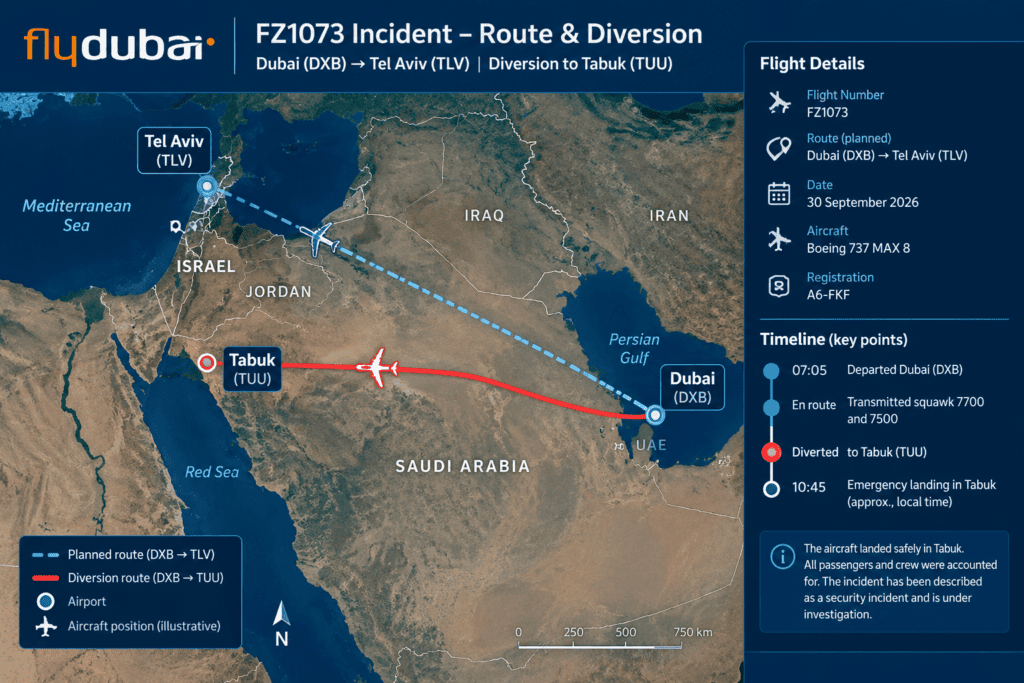
Flydubai FZ1073 was scheduled to fly from Dubai International Airport (DXB) to Ben Gurion International Airport (TLV) on September 30, 2026.
During the flight, the aircraft experienced an onboard incident that required the crew to divert to Saudi Arabia. Flydubai confirmed that the aircraft landed safely at Tabuk Airport and that passengers were safe and accounted for.
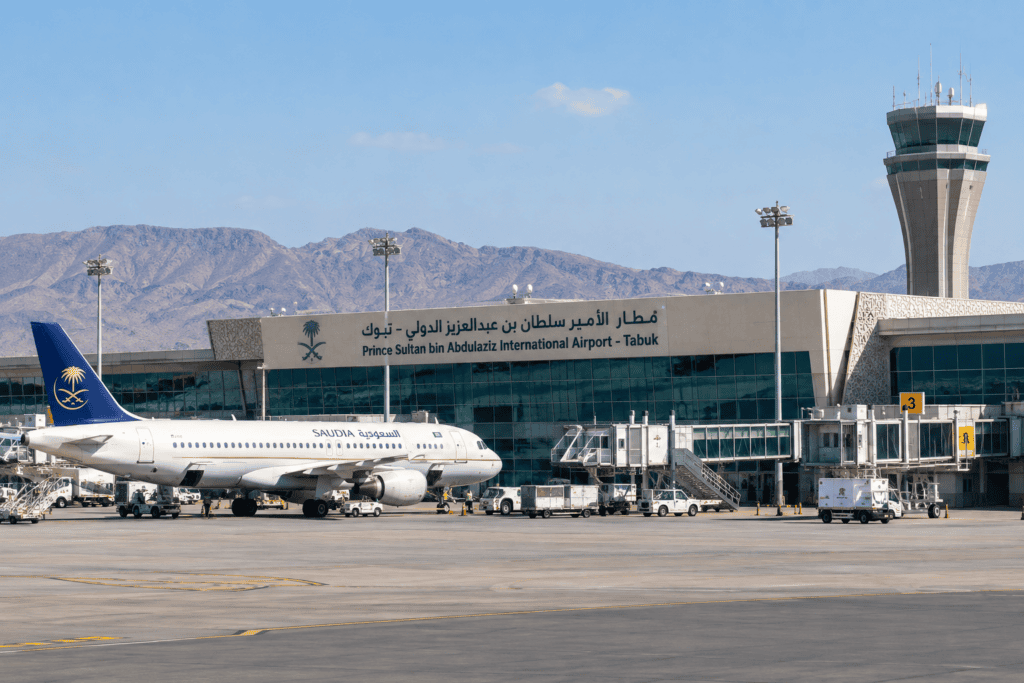
The UAE GCAA subsequently confirmed that the aircraft had experienced a security incident that was brought under control. The incident resulted in a diversion and emergency landing at Prince Sultan bin Abdulaziz International Airport in Tabuk.
The flight later continued its journey using replacement aircraft.
At a Glance
| Detail | Information |
|---|---|
| Flight | Flydubai FZ1073 |
| Route | Dubai (DXB) – Tel Aviv (TLV) |
| Date | September 30, 2026 |
| Aircraft | Boeing 737 MAX 8 |
| Registration | A6-FKF |
| Diversion airport | Tabuk, Saudi Arabia |
| Event classification | Security incident |
| Outcome | Safe emergency landing |
| Investigation | Ongoing |
Flight-tracking data records FZ1073 as departing Dubai and subsequently diverting to Tabuk.
Flydubai FZ1073 Incident Timeline
Understanding the sequence is important because several details of the event have been reported from different sources. Some operational information comes from flight-tracking data, while details about the onboard event come from airline and government statements.
Departure From Dubai
FZ1073 departed Dubai on September 30 for Tel Aviv.
The flight was operating normally before an emergency developed while the aircraft was en route. Flydubai later confirmed that an incident occurred onboard and that the aircraft ultimately landed safely in Tabuk.
Emergency Signals
Flight-tracking information indicates that the aircraft transmitted emergency squawk codes during the incident, including 7700 and 7500. Flightradar24 reported that the aircraft transmitted 7700 for a general emergency and 7500 for unlawful interference.
A squawk code alone does not explain exactly what happened inside an aircraft. It is an indication used within the air traffic-control environment, while the underlying circumstances must be established through the formal investigation.
Diversion to Tabuk
The aircraft diverted toward Tabuk in northwestern Saudi Arabia.
Saudi authorities said the competent authorities received an emergency declaration and granted the aircraft clearance to make an emergency landing. The aircraft landed safely at approximately 9:45 a.m. local time.
Emergency Landing
After landing, the passengers received assistance at the airport and injured crew members were taken for medical treatment.
The passengers were subsequently transferred to a replacement aircraft and continued toward their destination.
What Happened Inside the Cockpit?
This is the part of the incident that has attracted the greatest attention, but it is also where careful wording matters most.
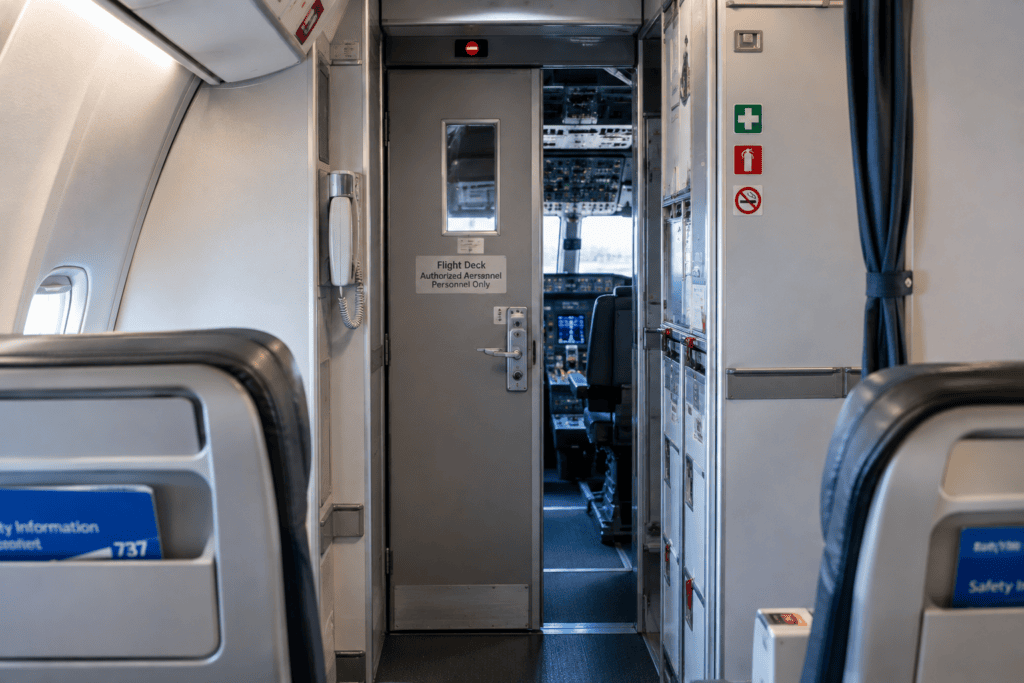
Flydubai confirmed that an altercation occurred in the flight deck and said the aircraft was secured by on-duty Flydubai crew members who were travelling on the flight. The airline also stated that the motives behind the incident were unknown and subject to formal investigation.
Saudi authorities later issued preliminary information concerning the incident. Reports based on Saudi statements said that the first officer assaulted the captain and that both sustained injuries.
Other media reports have described additional details about what happened in the cockpit and how passengers and crew intervened. However, those details should be treated according to their source and investigative status rather than presented as a final official account.
The distinction is important.
An aviation incident can involve information from flight data, crew statements, passengers, law-enforcement agencies, regulators and other sources. Early accounts can change as investigators reconstruct the event.
The UAE Attorney-General has specifically ordered an investigation to establish the facts, circumstances and motives surrounding the incident and to determine whether there was any connection to terrorist activity, prior planning or external direction. Authorities have urged the public not to circulate unverified information or reach conclusions before the investigation is complete.
How Was the Aircraft Secured?
According to Flydubai, on-duty crew travelling on the aircraft intervened and secured the aircraft before it landed safely at Tabuk.
Reports from passengers and other sources have described additional intervention inside the cabin.
From an aviation-operations perspective, the important point is not to turn those actions into a simplified movie-style narrative. The event involved a rapidly changing emergency in which flight crew, cabin occupants and authorities had to respond under abnormal circumstances.
The aircraft still had to be safely diverted, coordinated with air traffic control and brought to an airport capable of handling an emergency arrival.
That is where multiple layers of aviation safety and operational coordination become relevant.
What Do Authorities Say About the Incident?
UAE General Civil Aviation Authority
The UAE GCAA described the event as a security incident and confirmed that it resulted in a diversion and emergency landing at Tabuk.
The authority also confirmed injuries among crew members and said the investigation was ongoing. It warned against circulating unofficial information while investigators work to establish the facts.
Flydubai
Flydubai confirmed that FZ1073 experienced an incident while en route and that the aircraft landed safely at Tabuk.
The airline said all passengers were safe and accounted for and that its teams were working with the relevant authorities. Later statements confirmed that an altercation had occurred in the flight deck and that the aircraft had been secured by crew travelling on the flight.
Saudi Authorities
Saudi authorities confirmed that an emergency had been declared aboard FZ1073 and that the aircraft received clearance for an emergency landing at Tabuk.
The airport subsequently assisted passengers and arranged for their onward journey. Saudi authorities also launched investigative activity concerning the incident.
What Happened to the Passengers and Crew?
The most important immediate outcome is that the aircraft landed safely and passengers were subsequently able to continue their journey.
Saudi airport authorities said passengers received the necessary care at the terminal while arrangements were made with Flydubai for a replacement aircraft. The passengers later departed Tabuk for their final destination.
Crew members involved in the incident were taken for medical treatment.
The subsequent handling of passengers illustrates an important part of airline disruption management: an emergency does not necessarily end when an aircraft reaches the ground.
After a diversion, airline teams may need to coordinate:
- Passenger welfare and assistance
- Medical support
- Aircraft security
- Airport handling
- Replacement aircraft
- Crew arrangements
- Baggage and passenger reconciliation
- Communication with authorities
- onward transportation
- Schedule recovery
For airline operations teams, the recovery phase can be almost as important operationally as the initial diversion.
What Are the Operational Consequences?
The incident has already produced operational consequences for Flydubai and the wider aviation system.
Flydubai announced a temporary suspension of flights to and from Israel while the investigation continued.
The event also involves authorities across several jurisdictions because of the aircraft’s registration, operator, route, crew, passengers and location of the emergency landing.
The UAE Attorney-General’s office said its investigation would be coordinated with the GCAA and relevant UAE authorities.
For airline operations professionals, this highlights how an in-flight security event can quickly become a network-wide operational issue.
A single diverted flight can affect:
- Aircraft rotation
- Crew scheduling
- Passenger connections
- Airport resources
- Replacement aircraft
- Maintenance and inspection requirements
- Security coordination
- Regulatory reporting
- Subsequent flight schedules
This is one reason why operational control centers are critical during major disruptions.
For more background, see our guide to [Airline Operations Control] and how OCC teams coordinate diversions, aircraft status, crew, airport information and recovery operations.
What Does the Incident Mean for Aviation Security?
The Flydubai event also raises broader aviation-security questions, although it is too early to draw final conclusions about what changes should result from the investigation.
One area receiving attention is the distinction between external security threats and insider threats.
Modern commercial aviation uses extensive security controls around aircraft access, passengers, airports and flight decks. However, an incident involving someone already authorized to operate or access an aircraft raises a different set of security considerations.
That does not mean existing procedures have failed. It means investigators must examine the complete chain of events.
Potential areas for examination may include:
- Crew vetting
- Flight-deck access procedures
- Security reporting
- Crew coordination
- Threat assessment
- Emergency communication
- Cockpit and cabin procedures
- Response to unlawful interference
- Coordination between airlines, airports and authorities
The final conclusions should come from competent investigators rather than from early media reports.
Why Crew Resource Management Matters
Crew Resource Management, commonly known as CRM, is designed to support effective communication, coordination, decision-making and workload management among flight crew and other operational personnel.
The FZ1073 incident should not be used to make assumptions about specific CRM performance before investigators publish their findings.
However, the event demonstrates why aviation emergencies require coordinated action.
When an aircraft experiences an unexpected emergency, flight crews may have to manage several problems simultaneously:
- Aircraft control
- Communication with air traffic control
- Navigation
- Emergency procedures
- Passenger safety
- Medical issues
- Diversion planning
- Coordination with cabin crew
- Security concerns
The ability to prioritize aircraft control and communicate essential information becomes particularly important during abnormal situations.
The incident therefore provides a useful case study for aviation professionals examining how human factors, crew coordination and emergency response interact.
What Is Still Unknown?
Despite the amount of information already reported, several important questions remain open.
The exact motive
Authorities have not established a final motive. The UAE investigation specifically includes determining the circumstances and motives behind the incident.
Whether the incident was pre-planned
This is another matter investigators are examining.
Early political and media statements have included allegations about possible ideological motivation or planning. Those claims should not be treated as established findings unless supported by the formal investigation.
The complete sequence of events
Flight-tracking information can show an aircraft’s movement, altitude and emergency signals, but it cannot by itself establish everything that happened inside the flight deck.
Investigators will need to consider multiple sources of evidence.
What security changes may follow
It is also too early to know whether regulators or airlines will introduce permanent changes to crew-vetting, flight-deck security or other operational procedures.
Those decisions should follow evidence from the investigation rather than speculation.
What Airline Operations Professionals Can Learn From FZ1073
The incident is particularly relevant to airline operations because it demonstrates how quickly a security event can become an operational emergency.
1. Diversion planning matters
Airlines need suitable diversion options and procedures for unexpected situations.
2. Communication is critical
The flight crew, air traffic control, airline operations control, airport teams and emergency services may all become part of the response.
3. Recovery begins immediately
Once the aircraft lands, passenger assistance, crew support, aircraft security and onward transportation become operational priorities.
4. Information must be verified
In a rapidly developing incident, inaccurate information can spread quickly. Official statements and verified investigative findings should take priority.
5. Security and operational control are connected
A security emergency is not only a security department issue. It can affect aircraft routing, crew, airport handling, passenger management, schedules and regulatory reporting.
For a deeper look at how airline OCC teams handle disruptions and diversions, see our Airline Operations Control guide.
Frequently Asked Questions
What happened to Flydubai flight FZ1073?
Flydubai FZ1073, operating from Dubai to Tel Aviv on September 30, 2026, experienced a serious onboard security incident and diverted to Tabuk, Saudi Arabia, where it landed safely.
Where did Flydubai FZ1073 land?
The aircraft made an emergency landing at Prince Sultan bin Abdulaziz International Airport in Tabuk, Saudi Arabia.
Did everyone on Flydubai FZ1073 survive?
Flydubai confirmed that all passengers were safe and accounted for after the aircraft landed. Crew members were injured and received medical treatment.
Why did Flydubai FZ1073 divert to Saudi Arabia?
The aircraft diverted following an onboard incident that the UAE GCAA described as a security incident. The aircraft subsequently made an emergency landing in Tabuk.
What happened in the cockpit of FZ1073?
Flydubai confirmed that an altercation occurred in the flight deck. Saudi authorities subsequently reported preliminary findings concerning an assault involving the first officer and captain. The broader circumstances and motive remain under investigation.
Is the Flydubai FZ1073 investigation complete?
No. UAE authorities have ordered an investigation to establish the facts, circumstances and motives surrounding the incident. Authorities have also urged the public to avoid speculation and unverified information while the investigation continues.
Final Takeaway
The Flydubai FZ1073 incident is a serious aviation-security event that demonstrates how quickly an unexpected situation can develop into a complex operational emergency.
The aircraft diverted safely to Tabuk, passengers were accounted for, injured crew members received medical care, and passengers were later transported onward on replacement aircraft.
At the same time, important questions remain unanswered.
The exact motive, the complete sequence of events and any potential wider security implications should be established through the ongoing investigations rather than early speculation.
For aviation professionals, the incident provides a valuable reminder that flight safety depends on more than the aircraft itself. It also depends on effective crew coordination, emergency procedures, operational control, airport response, security systems and accurate communication.
As investigators release verified findings, the FZ1073 case will become clearer. Until then, the most responsible approach is to distinguish what is confirmed from what is still being investigated.