
Table of Contents
Aircraft load control is one of the most important behind-the-scenes functions in airline operations. Before an aircraft can depart, the airline must know not only how much it weighs, but also where passengers, baggage, cargo, mail, fuel and special loads are positioned. A small data error, an unreported loading change or an incorrect centre-of-gravity calculation can affect aircraft performance, structural limits, handling characteristics and operational safety.
This guide explains the seven essential aircraft load control duties, why weight and balance matter, how load controllers coordinate a flight turnaround, the tools they use, common errors to avoid and the career path for aviation professionals entering this field.

What Is Aircraft Load Control?
Aircraft load control is the operational process of planning, calculating, communicating and verifying the distribution of passengers, baggage, cargo, mail, fuel and other loads on an aircraft.
The purpose is to ensure the aircraft operates within approved limitations for:
- Weight
- Centre of gravity (CG)
- Structural loading
- Takeoff and landing performance
- Cargo-compartment restrictions
- Aircraft trim
- Dangerous-goods and special-load requirements
In practical terms, aircraft load control connects several airport and airline teams. A load controller may receive passenger figures from check-in or a departure control system, baggage and cargo data from ramp or cargo teams, fuel figures from the fuel provider or operations system, and aircraft configuration information from airline operations. That information is used to prepare a safe loading plan and final load-and-trim documentation.
IATA describes load control as a system that supports the safe and operationally appropriate use of aircraft capacity, including ensuring acceptable aircraft weight-and-balance conditions and proper load distribution.iata
Load control vs weight and balance
The terms load control and weight and balance are related, but they are not identical.
| Area | What it covers |
|---|---|
| Aircraft load control | The full operational process of collecting data, planning load distribution, coordinating aircraft loading, managing changes, preparing documents and confirming the final load |
| Aircraft weight and balance | The calculations used to determine aircraft mass, centre of gravity and compliance with approved limits |
| Ramp loading | The physical loading and unloading of baggage, cargo, mail, equipment and other items into the aircraft |
| Flight dispatch | The wider flight-operations function that may include flight planning, weather, operational flight plans, fuel planning and coordination with the flight crew |
A load controller does not simply “load bags.” The role is about making sure the planned load, actual load and flight documentation all match.
Role of the load controller
Depending on the airline, airport, aircraft type and handling arrangement, an aircraft load controller may:
- Collect passenger, baggage, cargo, mail and fuel figures
- Review aircraft type, registration and configuration
- Plan baggage and cargo distribution by compartment
- Calculate zero fuel weight, takeoff weight, landing weight and CG
- Issue loading instructions to ramp or ground-handling teams
- Prepare, amend or verify the load and trim sheet
- Manage last-minute changes, often called LMCs
- Coordinate with check-in, cargo, ramp, dispatch and cockpit crews
- Maintain documentation and records required by the operator
The exact responsibilities vary by airline and regulatory environment. However, the underlying principle remains the same: aircraft loading must match approved mass-and-balance requirements and operational procedures.
Why Aircraft Load Control Is Critical for Flight Safety
Aircraft load control is critical because every aircraft has limits. An aircraft cannot simply carry any amount of weight wherever space is available.
The FAA explains that the objective of an aircraft weight-and-balance control system is to calculate the aircraft’s takeoff weight and centre of gravity as accurately as possible.faa
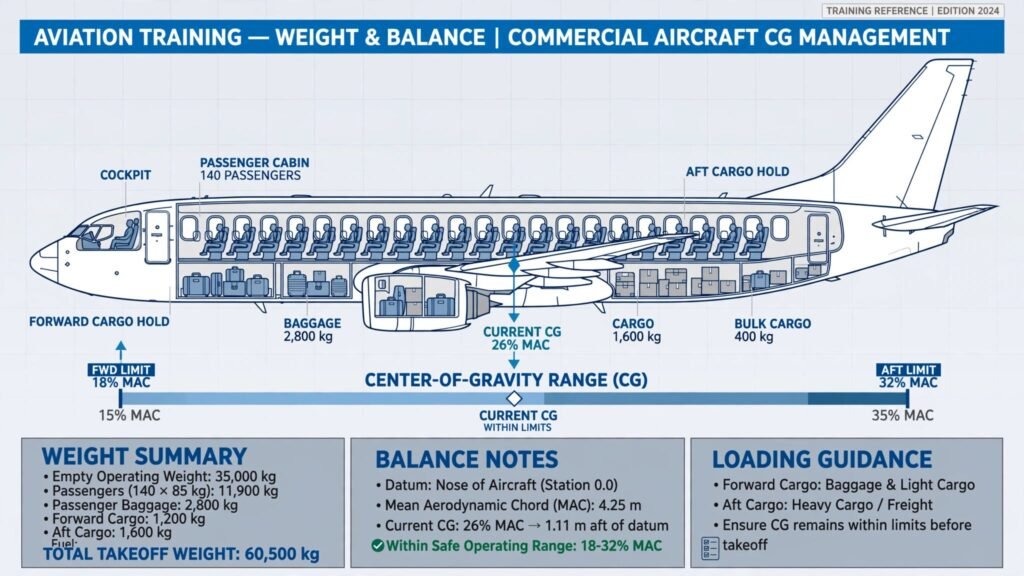
Aircraft centre of gravity
The centre of gravity is the point at which an aircraft’s total weight is considered to act. It must remain within approved forward and aft CG limits.
A CG that is too far forward or too far aft can affect handling and performance:
- A forward CG can increase control forces and may make rotation or flare more demanding.
- An aft CG can reduce longitudinal stability and may affect aircraft handling characteristics.
- A CG outside the approved envelope can create an unsafe condition even if the aircraft is below its maximum weight limit.
The basic weight-and-balance relationship is:
Centre of Gravity=Total WeightTotal Moment
The FAA notes that aircraft must remain within specified forward and aft CG limits for safe flight.faa+1
Maximum weight limitations
Load controllers work with several different aircraft weight limits. Each serves a different safety or structural purpose.
| Weight term | Meaning |
|---|---|
| Dry Operating Weight (DOW) | The aircraft’s operational weight before traffic load and usable fuel, based on the operator’s approved definition |
| Zero Fuel Weight (ZFW) | Aircraft operating weight plus passengers, baggage, cargo and mail, before usable fuel |
| Maximum Zero Fuel Weight (MZFW) | A structural limit that protects the aircraft, including wing-loading considerations |
| Ramp Weight | Aircraft weight before taxi fuel is burned |
| Takeoff Weight (TOW) | Aircraft weight at the start of the takeoff roll |
| Maximum Takeoff Weight (MTOW) | The maximum permitted takeoff mass, subject to aircraft and flight-specific restrictions |
| Landing Weight (LW) | Expected aircraft weight on arrival |
| Maximum Landing Weight (MLW) | The maximum permitted mass at landing |
An aircraft might be below its maximum takeoff weight but still have an unacceptable zero fuel weight, landing weight or CG position. That is why aircraft load control requires more than adding up passenger and baggage weights.
Structural limitations and aircraft performance
Correct loading affects more than balance. It also supports:
- Structural compliance
- Runway-performance calculations
- Takeoff-speed calculations
- Fuel and payload planning
- Aircraft trim calculations
- Compartment loading limits
- Cargo restraint and distribution requirements
- Efficient aircraft turnaround operations
Incorrect loading data can lead to delays, rework, offloading or a revised load-and-trim calculation. In serious cases, it can create a flight-safety risk.
7 Essential Aircraft Load Control Duties
1. Collect passenger and baggage data
The first major aircraft load control duty is collecting accurate flight data. A load controller needs reliable information before preparing a load plan or completing weight-and-balance calculations.
This may include:
- Number of adult, child and infant passengers
- Passenger seating or cabin-distribution data where applicable
- Checked-baggage totals
- Baggage weight or approved standard weights
- Cargo and mail weights
- Special loads
- Wheelchairs, live animals or perishables where applicable
- Dangerous-goods information
- Aircraft configuration
- Fuel figures
- Last-minute passenger or baggage changes
Passenger, baggage and cargo data can change throughout the turnaround. Check-in closes, standby passengers are accepted, bags are removed, cargo is added or offloaded, and fuel quantities may be revised.
The load controller must ensure that the final documentation reflects the final operational situation—not an earlier version of the flight data.
Example: If several passengers do not board but their checked bags remain loaded, the airline may need to follow its baggage-reconciliation procedures and revise the traffic-load data before departure.
2. Calculate aircraft weight and balance
The second duty is performing or validating aircraft weight-and-balance calculations.
The load controller combines aircraft operating data with the flight’s actual or approved traffic-load information. The aim is to confirm that the aircraft is within weight and centre-of-gravity limitations for the planned operation.
Typical calculations include:
- Dry Operating Weight
- Traffic load or payload
- Zero Fuel Weight
- Ramp Weight
- Takeoff Weight
- Landing Weight
- Centre of gravity
- Trim setting or trim reference, where required by aircraft and operator procedures
A modern airline may use an automated weight-and-balance system. However, the system is only as accurate as the data entered into it. If passenger numbers, baggage weights, fuel data, aircraft configuration or compartment distribution are incorrect, an automated calculation can still produce an incorrect operational result.
EASA rules require operators to establish mass-and-balance data and documentation before each flight, specifying the load and its distribution in a way that shows compliance with applicable aircraft limitations.easa.europa+1
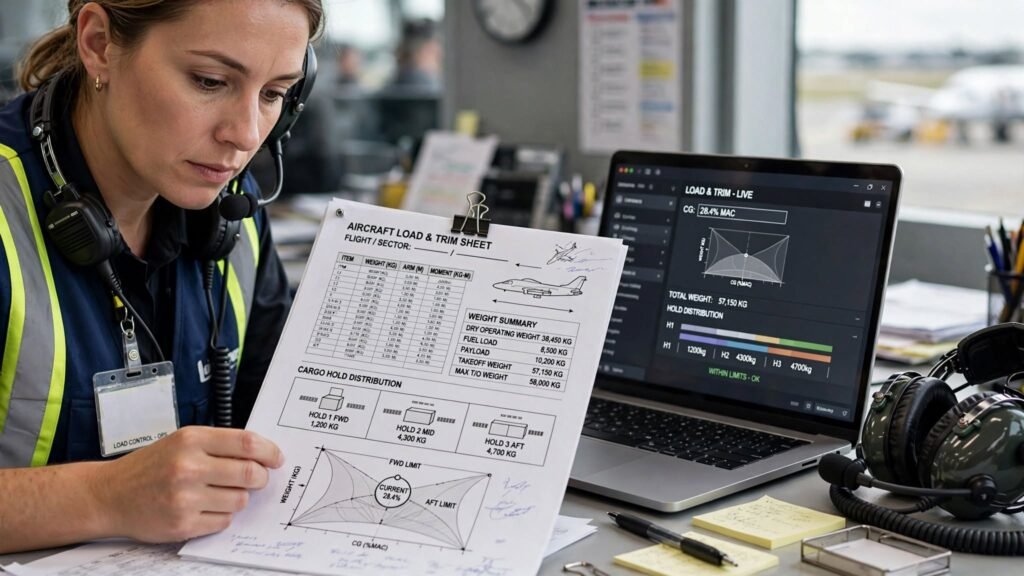
3. Prepare the load and trim sheet
The load and trim sheet is one of the most important documents in aircraft load control.
It provides a record of the flight’s relevant weight-and-balance information and helps communicate the final loading condition to the flight crew under the airline’s approved procedures.
A load and trim sheet may include:
- Flight number and date
- Aircraft type and registration
- Dry Operating Weight
- Passenger count and standard or actual passenger weights
- Baggage, cargo and mail weights
- Fuel figures
- Zero Fuel Weight
- Takeoff Weight
- Landing Weight
- Maximum permitted weights
- Compartment distribution
- Centre-of-gravity position
- Trim information
- Last-minute changes
- Required confirmations or signatures, depending on the system and procedure
IATA distinguishes between the load sheet and the Loading Instruction/Report. The load sheet contains flight-specific weight data and load distribution information, while loading instructions guide the person responsible for loading the aircraft and the report captures actual loading and deviations.iata
The load controller must communicate the correct final information to the cockpit crew. The flight crew needs accurate data to support safe operation, including the use of applicable performance and trim information.
4. Coordinate aircraft loading
Aircraft load control is highly collaborative. A load controller develops or communicates a load plan, but ramp and ground-handling teams normally perform the physical loading.
The load plan may specify:
- Which baggage or cargo goes into each hold
- Weight limits for individual cargo compartments
- Forward and aft hold distribution
- Loading sequence
- Use of bulk compartments or unit load devices
- Special-load positions
- Cargo-segregation requirements
- Load-restraint requirements
- Aircraft-specific restrictions
- Ballast requirements, if applicable
The ramp team needs clear, current instructions. If the actual load differs from the planned distribution, the deviation must be reported so the load controller can determine whether the documentation needs to be amended.
Aircraft loading must not be treated as a simple “fill every available space” activity. A hold may have space available but still be restricted by compartment weight limits, CG requirements, cargo compatibility or special-load procedures.
EASA guidance states that the person supervising aircraft loading must confirm that the load and its distribution comply with the mass-and-balance documentation given to the commander.easa.europa+1
5. Manage last-minute changes
Last-minute changes are normal in airline operations. The key is not avoiding every change—it is controlling, communicating and documenting every relevant change correctly.
Common LMCs include:
- Late passengers or no-shows
- Standby passengers accepted for travel
- Gate-checked baggage
- Offloaded baggage
- Added or removed cargo
- Cargo hold changes
- Revised fuel figures
- Aircraft substitution
- Aircraft configuration changes
- Passenger seating changes where relevant to the procedure
- Changes to special-load information
A last-minute change can affect aircraft weight, compartment distribution, CG, trim or documentation. The load controller must follow the airline’s approved procedures to decide whether the change can be handled through an LMC amendment or requires a complete recalculation and reissue of documentation.
The most important principle is that no significant difference should exist between:
- What was planned
- What was physically loaded
- What the load-and-trim documentation shows
- What the flight crew has been told
6. Verify final aircraft loading information
Before departure, a load controller must verify that final figures and physical loading information are consistent.
This is a critical quality-control stage. It may involve checking:
- Passenger numbers
- Baggage totals
- Cargo and mail weights
- Compartment distribution
- Aircraft registration and configuration
- Fuel data
- Maximum weight limits
- CG position
- Load-sheet figures
- LMC entries
- Special-load restrictions
- Dangerous-goods information
- Ramp confirmation or loading report
- Communication with the flight crew
This final cross-check protects against common operational errors such as data-entry mistakes, incorrect aircraft selection in a system, a bag count that changed after the calculation, or a ramp-loading deviation that was not reported.
The goal is not merely to finish the paperwork quickly. The goal is to ensure that the final aircraft condition is known, compliant and correctly communicated before departure.
7. Maintain load control records and documentation
Aircraft load control also involves documentation, record retention and audit readiness.
Depending on the operator, records may include:
- Load sheets
- Load-and-trim sheets
- Loading Instructions or LIRs
- Cargo documentation
- Passenger and baggage information
- LMC records
- Dangerous-goods documentation
- NOTOC information where applicable
- System audit trails
- Electronic approvals or signatures
- Communications records required by company procedures
These records support regulatory compliance, operational traceability, safety investigations, training, quality assurance and post-flight review.
The person who prepares mass-and-balance documentation must be identifiable, and operators must define the principles and methods used in their mass-and-balance systems.easa.europa+1
Essential Skills for Aircraft Load Control Professionals
Aircraft load control requires a combination of technical accuracy, operational awareness and communication skill.
Mathematical and analytical ability
Load controllers need confidence with numbers, weights, limits, calculations and data checks. They do not necessarily perform every calculation manually in a modern airline environment, but they must understand what the outputs mean and recognise when something looks wrong.
Weight-and-balance knowledge
A load controller should understand:
- CG principles
- Weight limitations
- Structural limits
- Load distribution
- Moment and arm concepts
- CG envelopes
- Trim requirements
- Aircraft configuration effects
- Fuel effects on aircraft mass and balance
Attention to detail
A small data-entry error can create an incorrect load sheet. Load controllers must carefully verify aircraft registration, flight number, passenger totals, baggage data, cargo information, fuel figures and compartment allocation.
Communication skills
The role depends on clear communication with:
- Check-in teams
- Gate agents
- Ramp teams
- Cargo departments
- Ground handlers
- Flight dispatchers
- Operations control centres
- Fuel providers
- Flight crew
A correct calculation that is not communicated correctly is not enough.
Decision-making under time pressure
Aircraft turnarounds are time-sensitive. A load controller must work quickly, but never compromise safety or approved procedures to protect punctuality.
Computer and systems proficiency
Modern airline load control commonly uses:
- Departure Control Systems
- Load-control software
- Weight-and-balance systems
- Digital load sheets
- Flight-planning systems
- Cargo systems
- Airline operational messaging systems
- Electronic document-management tools
IATA training for aircraft weight and balance includes core principles as well as automated load-sheet concepts, reflecting the technical and system-based nature of modern load-control work.iata
Aircraft Load Control Responsibilities During a Flight Operation
A load controller’s work follows the flight turnaround cycle.
| Flight stage | Typical aircraft load control activity |
|---|---|
| Pre-departure preparation | Review aircraft type, registration, configuration, planned fuel, expected passenger count and preliminary cargo or baggage data |
| Check-in coordination | Receive updated passenger figures, baggage information, special-service details and late changes |
| Cargo coordination | Confirm cargo, mail, special loads, dangerous-goods information and compartment requirements |
| Ramp coordination | Issue or communicate loading instructions, monitor load distribution and receive actual loading confirmation |
| Final calculation | Complete or amend weight-and-balance calculations, CG and trim information |
| Flight crew communication | Provide final load-and-trim information through the operator’s approved process |
| Post-departure documentation | Retain required records, audit trails, reports and amendments |
The turnaround can move quickly, but every team must work from consistent and current information.
Aircraft Load Control Tools and Systems
Modern aircraft load control combines aviation expertise with digital systems.
Load control software
Load-control software can calculate weights, CG and trim using aircraft-specific data and approved airline parameters. It may also generate load sheets, loading instructions and final operational messages.
Weight-and-balance systems
Weight-and-balance systems help controllers calculate:
- ZFW
- TOW
- LW
- CG position
- Trim
- Compartment restrictions
- Maximum allowable traffic load
- Structural and operational limits
Departure Control Systems
A Departure Control System, often called a DCS, may provide passenger counts, check-in status, baggage data and boarding information. These inputs are essential to final load-control accuracy.
Flight-planning and fuel systems
Fuel information affects ramp weight, takeoff weight, landing weight and CG planning. Accurate coordination with dispatch, flight operations and fueling processes is essential.
Manual contingency procedures
Even in a digital environment, airlines need approved contingency procedures for system outages, communication failures or unusual operations. Manual load-control processes must be carried out only by trained and authorised personnel using approved documents and procedures.
Automation improves speed and consistency, but it does not replace human verification. EASA guidance requires operators using computerised mass-and-balance systems to verify the integrity of the output data.aviation
Common Aircraft Load Control Errors
The following errors can affect aircraft loading safety and operational efficiency.
| Common error | Potential consequence |
|---|---|
| Incorrect passenger count | Wrong traffic-load calculation and inaccurate weight data |
| Incorrect baggage weight | Incorrect ZFW, TOW or CG calculation |
| Wrong cargo distribution | CG issues, compartment-limit exceedance or structural concerns |
| Incorrect aircraft registration | Using the wrong aircraft-specific data or configuration |
| Fuel figure not updated | Incorrect takeoff or landing weight calculation |
| Last-minute changes omitted | Mismatch between actual load and final documentation |
| Data-entry error | Incorrect output from an otherwise reliable system |
| Ramp deviation not communicated | Actual aircraft loading differs from the load plan |
| Incorrect special-load placement | Non-compliance with loading or segregation requirements |
| Communication failure | The flight crew or ramp team works from outdated information |
How Load Control Errors Can Affect Flight Safety
Aircraft load control errors can affect flight safety in several ways.
Incorrect centre of gravity
If the CG is outside approved limits, the aircraft may not handle as intended. Forward and aft CG conditions can create different operational challenges, and both must remain within the approved envelope.
Exceeded weight limitations
An aircraft may exceed a maximum zero fuel, takeoff or landing limitation. Each limitation must be checked separately.
Inaccurate performance information
Aircraft weight is a critical input for performance-related calculations. Incorrect weight information can affect takeoff planning, runway analysis and operational decision-making.
Incorrect trim data
Aircraft trim information may be linked to the calculated weight-and-balance condition. Incorrect data can lead to an inappropriate setting if not identified and corrected.
Operational delays and offloading
When a discrepancy is identified close to departure, the airline may need to hold the flight, offload baggage or cargo, revise fuel, update documentation or repeat the calculation. These actions may delay the flight, but they are necessary to restore compliance.

Aircraft Load Control Career Path
Aircraft load control can be an attractive career for people interested in airline operations, airport ground handling, aviation safety and flight turnaround management.
A typical progression may include:
| Career stage | Typical focus |
|---|---|
| Entry-level airport or ground-operations role | Learning turnaround processes, baggage handling, ramp safety, check-in or cargo operations |
| Load Controller | Preparing load plans, calculations, documentation and coordinating with operational teams |
| Senior Load Controller | Handling complex flights, mentoring staff, resolving disruptions and supporting quality control |
| Load Control Supervisor | Supervising daily operations, staffing, compliance, training and turnaround performance |
| Load Control Manager | Managing systems, procedures, training, quality assurance and operational standards |
| Related aviation roles | Flight dispatch, operations control, ramp operations, cargo operations, safety and compliance, airport duty management |
Qualifications and training
Requirements vary by airline, ground-handling company and country. However, employers commonly value:
- Secondary education or equivalent
- Aviation, logistics or airport-operations knowledge
- Airline or airport ground-operations training
- Aircraft weight-and-balance training
- Familiarity with airline systems
- Dangerous-goods awareness appropriate to the role
- Strong English communication skills
- Computer proficiency
- Ability to work shifts, weekends and irregular hours
- On-the-job training and recurrent training
A formal aviation degree is not always required, but technical understanding, accuracy and operational discipline are essential.
Career skills that support progression
Professionals can advance faster by developing:
- Aircraft-type knowledge
- Weight-and-balance expertise
- Leadership ability
- Decision-making under pressure
- Safety and compliance awareness
- Airline systems knowledge
- Cargo and dangerous-goods awareness
- Strong cross-functional communication
- Operational problem-solving skills
Aircraft Load Control vs Flight Dispatch
Aircraft load control and flight dispatch work closely together, but their core responsibilities differ.
| Aircraft load control | Flight dispatch |
|---|---|
| Focuses on aircraft loading, weight, balance, CG and load distribution | Focuses on broader operational flight planning and support |
| Coordinates with ramp, baggage, cargo and gate teams | Coordinates with flight crew, operations control, air traffic, weather and other operational stakeholders |
| Prepares or supports load-and-trim documentation | May prepare or support flight plans, fuel planning and operational releases depending on the airline and regulations |
| Manages LMCs affecting passengers, baggage, cargo and loading distribution | Assesses operational changes that affect the flight plan, fuel, routing or flight release |
| Confirms the aircraft is loaded within approved limits | Supports safe and efficient execution of the overall flight operation |
The two functions exchange important information, especially aircraft registration, aircraft configuration, fuel figures, payload, operational restrictions and final departure status.
Aircraft Load Control Checklist
Use this educational checklist to understand the typical final-verification process. It does not replace an airline’s approved manuals, load-control system or regulatory procedures.
- Passenger data verified
- Baggage, cargo and mail data verified
- Special loads reviewed
- Dangerous-goods information handled through the approved process
- Aircraft registration and configuration confirmed
- Fuel figures confirmed
- Dry Operating Weight checked
- Zero Fuel Weight calculated
- Takeoff Weight calculated
- Landing Weight calculated
- Maximum weight limitations checked
- Centre of gravity checked against approved limits
- Cargo-compartment distribution verified
- Loading instruction or LIR completed as required
- Last-minute changes incorporated
- Final load-and-trim documentation completed
- Ramp or loading confirmation received
- Flight crew informed through the approved procedure
- Required records retained
Frequently Asked Questions
What does an aircraft load controller do?
An aircraft load controller plans and verifies how passengers, baggage, cargo, mail and fuel are distributed on an aircraft. The role involves weight-and-balance calculations, load sheets, loading instructions, last-minute changes, ramp coordination and communication with the flight crew.
What is a load and trim sheet?
A load and trim sheet is a flight-specific document that records weight-and-balance information, including traffic load, fuel, aircraft weight, CG and relevant trim information. It supports safe aircraft operation by confirming that the aircraft is within approved loading limitations.
What is an LIR in aviation?
LIR commonly refers to a Loading Instruction/Report. It is used to communicate how an aircraft should be loaded and to record the actual load distribution or any deviations from the plan. IATA distinguishes this operational document from the flight load sheet.iata
What is an LMC in aircraft load control?
LMC means Last-Minute Change. It refers to a change after initial load-control planning, such as a passenger no-show, bag removal, added cargo, fuel revision or compartment change. The change must be handled under the airline’s approved procedures.
Is aircraft load control a good aviation career?
Aircraft load control can be a strong career option for people who enjoy aviation operations, precision, data, safety and time-critical teamwork. It can also lead to opportunities in airline operations control, ramp supervision, flight dispatch, cargo operations and aviation safety.
Conclusion
Aircraft load control is a vital airline function that helps ensure every flight departs within approved weight, balance, CG and structural limits. The role requires far more than basic calculations: it combines data accuracy, operational coordination, ramp communication, documentation, time management and safety awareness.
The seven essential aircraft load control duties are collecting accurate flight data, calculating weight and balance, preparing load-and-trim documentation, coordinating loading, managing last-minute changes, verifying final loading information and maintaining records.
For aviation professionals, load control offers a practical and safety-focused career path at the centre of airline ground and flight operations. The most successful load controllers understand that every passenger count, baggage figure, cargo position, fuel update and load-sheet amendment matters—because safe flight operations depend on accurate information and disciplined communication.