
A load sheet is the operational document that summarizes an aircraft’s final loading condition before departure. It helps the flight crew verify that the aircraft’s weight, balance, and trim remain within approved limits after passengers, baggage, cargo, fuel, and special loads are accounted for.
Table of Contents
What Is an Aircraft Load Sheet?
The load sheet records the weights used for departure calculations and shows how the payload is distributed across the aircraft. Depending on the airline and aircraft type, it may be produced electronically or on an approved paper form. The load controller, not the software alone, remains responsible for checking the operational inputs and following the airline’s approved procedures.
What Information Does a Load Sheet Contain?
- Aircraft identification: registration, flight number, route, date, and aircraft configuration.
- Weight data: dry operating weight, traffic load, zero fuel weight, takeoff weight, and landing weight.
- Fuel figures: block fuel, taxi fuel, trip fuel, reserves, and estimated fuel remaining at landing.
- Load distribution: passenger, baggage, cargo, mail, and special-load details by compartment or zone.
- Balance information: center-of-gravity or index data, trim setting, and applicable limits.
- Operational signatures: preparation, checking, acceptance, or electronic authorization records.
Load Sheet As Document
Before an aircraft leaves the gate, several teams work together to confirm that it is correctly loaded. Passengers board, baggage is placed in the aircraft holds, cargo is secured, fuel is added, and final figures are checked.
An aircraft load sheet brings much of this information together. It records the aircraft’s weight, balance condition, fuel, passengers, baggage, cargo, mail, and load distribution for a specific flight.
This document helps the airline and flight crew confirm that the aircraft is operating within its approved weight and balance limits. In this article, we will explain seven essential aircraft load sheet facts, the information included in the document, common weight terms, centre-of-gravity calculations, last-minute changes, and frequent errors.

Important: This article is for educational purposes only. Operational load sheets must be prepared, checked, and approved by trained personnel using the airline’s approved systems and procedures.
Why the Aircraft Load Sheet Matters
An aircraft load sheet is more than a list of passengers and baggage. It is a flight-specific document that helps confirm whether the aircraft has been loaded within approved weight and balance limits.
The document connects several parts of airline operations, including:
- Passenger and baggage processing.
- Cargo and mail handling.
- Aircraft loading.
- Fuel planning.
- Weight and balance calculations.
- Flight crew communication.
- Final departure documentation.
The International Air Transport Association describes a load sheet as a legal document that states the weight data and balance condition of the loaded aircraft for an individual flight.[airtechzone.iata]
A load sheet is important because aircraft safety depends on both total weight and weight distribution. An aircraft may be below its maximum takeoff weight but still have an unsafe centre-of-gravity position or incorrect cargo distribution.
What this article explains
This guide covers seven essential aircraft load sheet facts, the information found on the document, aircraft weight terminology, centre-of-gravity principles, last-minute changes, common load-sheet errors, and the difference between a load sheet and a load-and-trim sheet.
What Is an Aircraft Load Sheet?
An aircraft load sheet is a flight-specific document that records an aircraft’s weight, load distribution, balance condition, fuel, and related departure information.
The exact format varies between airlines, aircraft types, countries, and approved load-control systems. Some operators use paper documents, while others use electronic load sheets or approved digital transmission systems.
Regardless of the format, the purpose remains similar: to communicate accurate mass-and-balance information for the aircraft’s actual departure condition.
Purpose of the document
An aircraft load sheet helps confirm that:
- The aircraft is not above its approved weight limitations.
- The centre of gravity is within approved forward and aft limits.
- Passengers, baggage, cargo, and mail are correctly included.
- Fuel information is current.
- Last-minute changes have been included or handled correctly.
- The flight crew receives accurate final loading information.
Regulatory mass-and-balance requirements commonly include aircraft operating mass, fuel, passengers, baggage, freight, zero fuel mass, takeoff mass, landing mass, centre-of-gravity information, and applicable limiting values.[regulatorylibrary.caa.co][regulatorylibrary.caa.co]
Who prepares and checks the load sheet?
Depending on the airline’s organisation, the load sheet may be prepared by a load controller, load planner, flight-operations specialist, ground-handling company, or another authorised person.
The final document may be checked through automated system validation, an independent review, ramp confirmation, supervisor approval, electronic acknowledgement, or communication with the flight crew.
The exact responsibilities vary between operators. Readers should not assume that every airline prepares, verifies, and approves load sheets in exactly the same way.
7 Essential Aircraft Load Sheet Facts
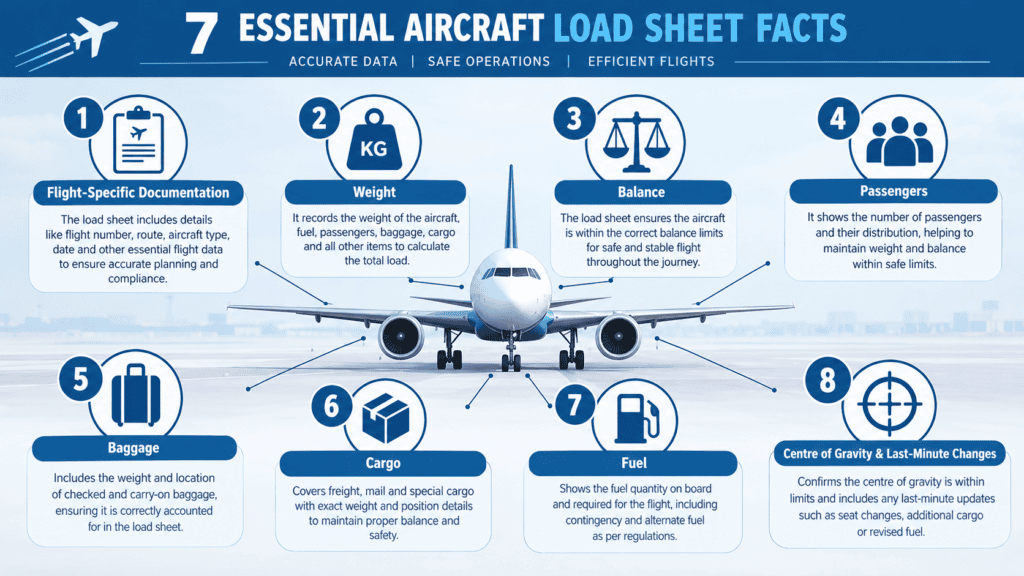
1. An aircraft load sheet is flight-specific
An aircraft load sheet belongs to a particular flight operation. It is connected to details such as:
- Flight number.
- Date and route.
- Aircraft type.
- Aircraft registration.
- Flight sector.
- Passenger load.
- Baggage, cargo, and mail.
- Fuel quantity.
- Load distribution.
A load sheet from a previous flight cannot simply be reused. Even when the same aircraft operates the same route, passenger numbers, baggage, cargo, fuel, and aircraft configuration may be different.
Why this fact matters
Weight and balance are not permanent conditions. They change whenever the load, fuel, aircraft configuration, or distribution changes. The load sheet must describe the aircraft as it is prepared for that specific departure.
2. It records aircraft weight and balance
An aircraft load sheet is not only a record of total weight. It also supports the calculation of aircraft balance and centre of gravity.
Weight tells the airline how heavy the aircraft is. Balance tells the airline where that weight is positioned.
Two aircraft can have the same total weight but different balance conditions. For example, one aircraft may carry more weight in its forward hold, while another carries the same amount in its aft hold. Their total weight may be identical, but their centre-of-gravity positions may be different.
The FAA explains that centre of gravity can be determined by dividing total moment by total weight. A moment is created by multiplying weight by its distance from a reference point, known as the arm.[skybrary]
The simplified relationship is:
\text{Centre of Gravity} = \frac{\text{Total Moment}}{\text{Total Weight}}3. Passengers, baggage, cargo, mail, and fuel all affect the load
Every major load component affects the aircraft’s final weight and balance condition.
- Passengers add weight and may affect cabin distribution.
- Checked baggage adds weight and is placed in one or more cargo holds.
- Cargo and mail add weight and may be positioned in specific compartments.
- Fuel adds significant weight and may change as it is burned during flight.
- Special loads may require specific positions or handling procedures.
Airlines may use actual weights, approved standard weights, or other approved methods for passengers and baggage. The method depends on the operator’s procedures and applicable regulations.
The most important point is that the information entered into the load sheet must come from reliable and approved sources.
4. The centre of gravity must remain within approved limits
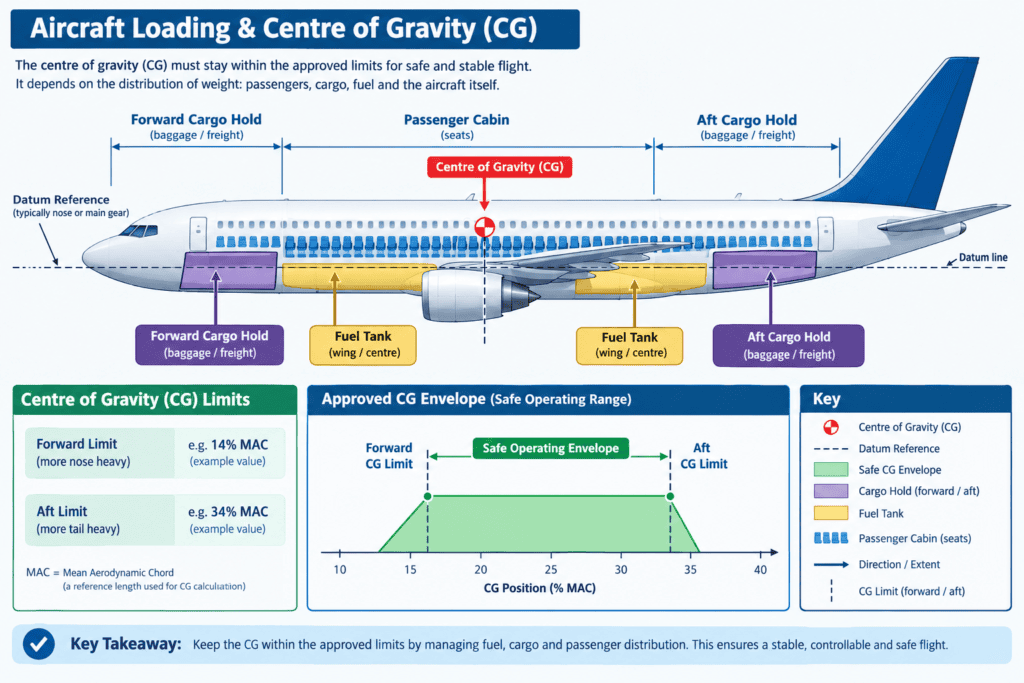
The centre of gravity, or CG, is the theoretical point at which the aircraft’s total weight acts. It changes according to the location of passengers, baggage, cargo, mail, and fuel.
Every aircraft has an approved centre-of-gravity envelope, which normally includes forward and aft limits.
- A forward CG may increase control forces and affect rotation or landing flare characteristics.
- An aft CG may reduce longitudinal stability and affect handling.
- A CG outside the approved range may create an unsafe operating condition.
Keeping the aircraft below its maximum takeoff weight is not enough. The centre of gravity and load distribution must also remain within approved limits. FAA guidance explains that aircraft loading affects stability, controllability, power requirements, and fuel consumption.[faasafety]
5. Last-minute changes can alter the load sheet
Airline operations can change until the aircraft door closes. A passenger may arrive late, a checked bag may be removed, cargo may be offloaded, or the fuel quantity may be revised.
Common last-minute changes include:
- Late passengers.
- Passenger no-shows.
- Standby passengers.
- Gate-checked baggage.
- Offloaded baggage.
- Added or removed cargo.
- Changes in cargo-hold distribution.
- Fuel revisions.
- Aircraft substitutions.
- Changes to special-load information.
These changes are often called Last-Minute Changes, or LMCs. The UK Civil Aviation Authority explains that an LMC process can be used to enter approved late changes into a final manual or electronic load sheet without necessarily preparing an entirely new document.[caa.co]
However, an LMC process must follow the operator’s approved procedures. If the change is outside the permitted limits, new mass-and-balance documentation may be required.
6. A load sheet is different from a load-and-trim sheet
The terms may be used differently by different airlines, but they generally describe related documents or functions.
| Document or term | Typical purpose |
|---|---|
| Aircraft load sheet | Records flight-specific weight data, load components, distribution, and balance condition. |
| Load-and-trim sheet | May include weight, balance, distribution, and aircraft trim information. |
| Loading Instruction | Provides instructions for distributing baggage, cargo, mail, stores, or other loads. |
| Loading Instruction/Report | May include planned loading instructions and a report of actual loading or deviations. |
These documents should not be treated as identical in every airline environment. Their names, fields, and workflows may vary according to aircraft type, airline procedures, software, and regulatory approval.
7. The final load sheet must match the actual aircraft load
The final aircraft load sheet should reflect the aircraft’s actual loaded condition before departure.
This means the final figures must account for relevant changes in:
- Passenger numbers.
- Baggage weight.
- Cargo and mail.
- Fuel quantity.
- Load distribution.
- Aircraft configuration.
- Special loads.
EASA guidance states that mass-and-balance documentation is expected to reflect the actual loaded state of the aircraft before departure. It also says that final documentation should include changes made after the initial documents were issued.[easa.europa]
A correct calculation based on old information is not a correct final load sheet.
Key Information Found on an Aircraft Load Sheet
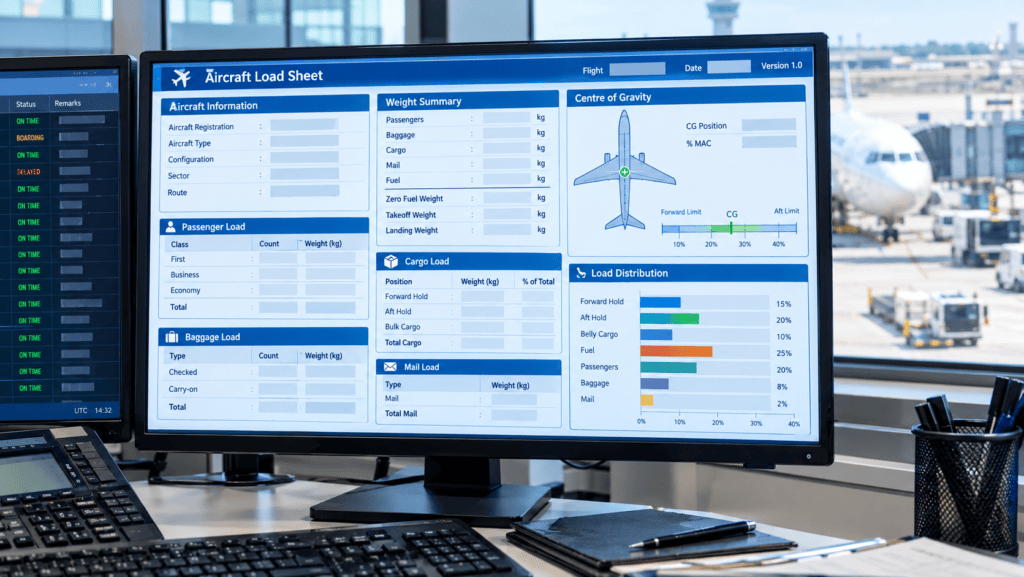
The exact layout varies, but an aircraft load sheet commonly includes several categories of information.
Aircraft identification
The document normally identifies the flight and aircraft. This may include:
- Flight number.
- Date.
- Departure and destination airports.
- Aircraft type.
- Aircraft registration.
- Flight sector.
- Aircraft configuration.
Aircraft identification is important because weight-and-balance data may be specific to the aircraft registration or configuration.
Passenger information
The load sheet may show passenger totals by cabin, passenger category, destination, or approved loading group. Depending on the airline system, passenger figures may come from the departure control system or another authorised source.
Baggage, cargo, and mail
The document may record baggage, cargo, mail, freight, ballast, and other traffic-load components. It may also show the location of these items in forward, aft, bulk, or other approved compartments.
Fuel information
Fuel information may include fuel at ramp, fuel at takeoff, trip fuel, taxi fuel, reserve fuel, or other categories defined by the operator’s system.
Fuel is important for two reasons. It adds weight, and its location changes as it is consumed during flight.
Weight and balance figures
Depending on the document and system, the load sheet may include:
- Dry Operating Weight.
- Zero Fuel Weight.
- Ramp Weight.
- Takeoff Weight.
- Landing Weight.
- Maximum weight limitations.
- Centre-of-gravity position.
- Index or moment values.
- Trim information.
Load distribution
The load sheet may show how the load is distributed throughout the cabin, cargo holds, containers, compartments, or loading zones.
This distribution matters because the location of the weight affects aircraft balance, not only the total mass.
Understanding Aircraft Weight Calculations
Aircraft load sheets use several weight terms. These terms help the airline and flight crew understand the aircraft’s mass at different stages of departure and flight.
Dry Operating Weight
Dry Operating Weight, or DOW, is the aircraft’s operational weight before the traffic load and usable fuel are added.
The exact items included depend on the airline’s approved definition. It may include the aircraft, operating crew, catering, potable water, equipment, and other operational items.
Traffic load
Traffic load generally includes passengers, baggage, cargo, and mail. It may also include other load components identified by the operator.
Zero Fuel Weight
Zero Fuel Weight, or ZFW, is generally calculated as:
\text{ZFW} = \text{Dry Operating Weight} + \text{Traffic Load}ZFW must remain below the aircraft’s Maximum Zero Fuel Weight, or MZFW. This limit is linked to structural considerations and is separate from Maximum Takeoff Weight.
Ramp weight
Ramp Weight is the aircraft’s weight before taxi fuel is burned. It is normally higher than Takeoff Weight because the aircraft consumes fuel while taxiing.
Takeoff weight
Takeoff Weight, or TOW, is the aircraft’s mass at the start of the takeoff roll.
A simplified relationship may be shown as:
\text{Takeoff Weight} = \text{Ramp Weight} - \text{Taxi Fuel}The exact calculation and terminology depend on the aircraft and operator’s approved procedures.
Landing weight
Landing Weight is the aircraft’s expected mass when it lands. It is based on the departure weight and expected fuel burn.
The aircraft must remain within its Maximum Landing Weight, or MLW, for the relevant operation.
Why accurate weight figures matter
Weight affects aircraft performance, fuel planning, runway requirements, structural limitations, and landing limitations.
Incorrect weight data can result in incorrect operational calculations or a need to delay the flight while the figures are corrected.
Understanding Aircraft Balance and Centre of Gravity
Aircraft balance describes how the aircraft’s weight is distributed around its reference point. The centre of gravity is the point where the aircraft would balance if its total mass were concentrated at one location.
How loading changes the centre of gravity
Loading weight farther forward tends to move the CG forward. Loading weight farther aft tends to move it aft.
Several factors can change the CG:
- Passenger distribution between cabins.
- Baggage loaded in forward or aft holds.
- Cargo-container location.
- Mail and freight placement.
- Fuel location and fuel burn.
- Ballast or special-load positioning.
- Aircraft configuration.
Forward and aft CG considerations
A forward CG may increase the control force required during some phases of flight and can affect rotation and landing flare characteristics.
An aft CG may reduce longitudinal stability and affect aircraft handling. The precise effects depend on the aircraft type, loading condition, flight phase, and approved operating data.
For this reason, the load sheet must confirm that the aircraft remains within its approved centre-of-gravity envelope.
Why balance matters as much as weight
Consider two aircraft with the same total traffic load. In the first aircraft, most of the cargo is in the forward hold. In the second, the same cargo is in the aft hold.
The total weight is the same, but the centre of gravity may be different. This shows why an aircraft load sheet must record both how much weight is carried and where it is located.
How Passengers, Baggage, Cargo, and Fuel Affect the Load
Passenger distribution
Passenger weight contributes to the traffic load. Passenger location can also affect balance, particularly when the cabin is divided into separate zones or when the aircraft has a smaller capacity.
Airlines use approved methods to determine passenger mass. These may involve standard passenger weights, actual weights, or other approved procedures.
Checked baggage
Checked baggage can represent a significant portion of the traffic load. Its effect depends on both total weight and location.
For example, a baggage increase in an aft hold may have a different effect on the CG than the same increase in a forward hold.
Cargo and mail
Cargo and mail may be loaded in dedicated compartments, containers, pallets, or bulk holds. The load controller must consider:
- Total cargo weight.
- Compartment limits.
- Container or pallet positions.
- Load distribution.
- Cargo restraint requirements.
- Special-load restrictions.
- Dangerous-goods information where applicable.
Fuel quantity and location
Fuel affects aircraft weight and can also influence balance. During flight, fuel is consumed, so the aircraft’s weight and CG may change.
Fuel information used on the load sheet must be current and consistent with the operator’s flight-planning and fuelling procedures.
The same weight can create different balance conditions
A useful principle for readers to remember is:
Weight tells you how heavy the aircraft is. Balance tells you where that weight is acting.
That is why the load sheet must include or support load-distribution information, not just a single total-weight figure.
How an Aircraft Load Sheet Is Prepared
Preparing an aircraft load sheet is a coordinated process. The steps can vary by airline, but the general workflow is similar.
Step 1: Identify the aircraft and flight
The load-control team confirms the flight number, route, aircraft registration, aircraft type, configuration, and operating sector.
Step 2: Collect passenger and baggage information
Passenger figures, baggage totals, cabin information, and special-service data are collected from approved airline systems or operational teams.
Step 3: Collect cargo, mail, and special-load information
Cargo and mail teams provide weights, descriptions, compartment requirements, and relevant special-load information.
Dangerous-goods information must be handled through the operator’s approved process.
Step 4: Confirm fuel information
The load-control process receives the applicable fuel figures from the approved operational source.
Fuel changes must be communicated because they affect aircraft weight and may affect balance.
Step 5: Calculate aircraft weights
The system or authorised personnel calculate DOW, ZFW, ramp weight, TOW, landing weight, and other required values.
Step 6: Determine balance and centre of gravity
The load distribution is assessed to determine the aircraft’s centre-of-gravity position, index, moment, trim, or other approved balance values.
Step 7: Check operational limits
The calculated figures are compared with applicable limits, including:
- Maximum Zero Fuel Weight.
- Maximum Takeoff Weight.
- Maximum Landing Weight.
- Compartment weight limits.
- Centre-of-gravity limits.
- Aircraft configuration restrictions.
Step 8: Issue loading instructions
The ramp or loading team receives instructions about where baggage, cargo, mail, and other loads should be placed.
Step 9: Confirm the actual loading
The physical load is checked against the plan. Any difference between planned and actual loading must be communicated to load control.
Step 10: Complete final verification
The final load sheet is completed or amended according to approved procedures. Relevant information is communicated to the flight crew, and required records are retained.
Aircraft Load Sheet vs Load and Trim Sheet
The words “load sheet” and “load-and-trim sheet” are sometimes used differently by different airlines. They are closely related, but the exact fields and document names depend on the approved system and aircraft type.
What a load sheet contains
A load sheet generally records the flight’s weight data, load components, fuel, passengers, baggage, cargo, mail, load distribution, and balance condition.
What a trim sheet contains
A trim sheet may show the aircraft trim setting or trim reference calculated from the aircraft’s loading and balance condition.
In some systems, weight, balance, and trim appear together on one document.
How the documents relate
The load sheet shows the aircraft’s loading and weight-and-balance condition. The trim information may then be used to support the appropriate aircraft setup before departure, according to the aircraft and operator’s procedures.
Not every airline or aircraft uses the same document layout. Some operators use a combined electronic load-and-trim sheet, while others present the information in separate sections or systems.
Departure Documentation and the Load Sheet
An aircraft load sheet forms part of the wider departure documentation process. It works alongside other operational information used by the airline, ground teams, and flight crew.
Final loading information
Before departure, the final documentation must show the aircraft’s actual loading condition as accurately as required by the operator’s procedures.
This includes relevant changes made after a preliminary or provisional load sheet was issued.
Last-minute changes
A last-minute change may involve a passenger, baggage item, cargo shipment, fuel quantity, hold position, or special load.
The change must be:
- Identified.
- Communicated to responsible load-control personnel.
- Assessed for its effect on weight and balance.
- Entered into the approved system or LMC process.
- Communicated to the appropriate operational personnel.
- Included in the final documentation.
Communication with the flight crew
The commander or flight crew must receive final information through the airline’s approved process.
The method may involve paper documentation, electronic transmission, onboard communication, or another approved system.
The goal is always the same: the crew should have accurate information about the aircraft’s final loading condition before departure.
What Happens When the Load Changes?
A load sheet may be prepared before every passenger has boarded and before the final baggage and cargo situation is completely closed. This is why airlines need procedures for changes near departure.
Additional passengers
A late passenger or accepted standby passenger can increase the passenger count and traffic load. Depending on the passenger’s seating zone and the airline’s procedure, the change may also affect balance.
Baggage or cargo changes
Added or removed baggage and cargo changes the aircraft’s mass. If the item is placed in a different compartment, it may also change the centre of gravity.
Fuel changes
A change in fuel quantity can affect ramp weight, takeoff weight, landing weight, and balance calculations.
Offloaded items
Removing baggage or cargo does not automatically make the final figures correct. The location and weight of the removed item must be considered, and the documentation must be updated where required.
When recalculation is needed
The operator’s approved procedures determine whether an LMC entry is sufficient or whether new mass-and-balance documentation must be prepared.
Regulatory guidance requires operators to specify procedures for late load changes, including permitted change limits and situations where new documentation is required.[regulatorylibrary.caa.co]
Common Aircraft Load Sheet Errors to Avoid
Aircraft load-sheet errors can result from incorrect source data, poor communication, manual entry mistakes, or a failure to record a change.
| Common error | Possible effect |
|---|---|
| Incorrect passenger count | Incorrect traffic load and total aircraft weight. |
| Incorrect baggage or cargo weight | Incorrect ZFW, TOW, landing weight, or CG result. |
| Wrong aircraft registration | Use of incorrect aircraft-specific weight or configuration data. |
| Incorrect compartment allocation | Incorrect balance, compartment-limit issue, or structural concern. |
| Fuel discrepancy | Incorrect ramp, takeoff, or landing weight. |
| Failure to record an LMC | Final documents do not match the actual aircraft load. |
| Data-entry error | Incorrect system result even when the software works correctly. |
| Unreported ramp deviation | Physical loading differs from the planned loading instruction. |
| Inadequate final verification | An error may remain undetected before departure. |
How operators reduce these errors
Airlines and ground handlers may use:
- Automated system validation.
- Independent figure checks.
- Aircraft-registration checks.
- Compartment-weight warnings.
- Gross-error checks.
- Ramp-loading confirmation.
- Electronic approval or acknowledgement.
- Clear LMC procedures.
- Staff training and recurrent training.
- Audit trails and record retention.
The UK Civil Aviation Authority highlights the importance of checking flight details, aircraft registration, dry operating mass, zero fuel mass, takeoff mass, landing mass, fuel, hold distribution, passenger numbers, baggage, and the final reconciliation between the load sheet and loading instruction/report.[caa.co]

Why Accurate Aircraft Load Sheets Are Critical
Maintaining aircraft weight limitations
The aircraft load sheet helps confirm compliance with weight limits such as MZFW, MTOW, and MLW.
These limitations have different purposes and must be checked separately.
Maintaining centre-of-gravity limits
The load sheet supports the calculation and verification of the aircraft’s CG. The aircraft must remain within its approved forward and aft CG limits.
Supporting aircraft performance
Aircraft weight affects operational performance. Incorrect weight information can affect takeoff calculations, landing planning, fuel planning, and runway-performance assessments.
Providing accurate departure information
The load sheet gives the flight crew and relevant operational teams a final picture of the aircraft’s loading condition.
Meeting operational and regulatory requirements
Mass-and-balance documentation is part of an operator’s approved operational system. It supports regulatory compliance, accountability, safety monitoring, and post-flight traceability.
The UK Civil Aviation Authority states that mass-and-balance documentation must enable the commander to determine that the aircraft’s mass and load distribution do not exceed applicable limits.[regulatorylibrary.caa.co]
Aircraft Load Sheet Example: A Simplified Walkthrough
The following example is for learning only. It uses fictional figures and does not represent any real aircraft, airline, approved load sheet, or operational calculation.
Simplified aircraft data
| Item | Example value |
|---|---|
| Dry Operating Weight | 42,000 kg |
| Passenger load | 11,500 kg |
| Baggage and cargo | 3,500 kg |
| Zero Fuel Weight | 57,000 kg |
| Usable fuel | 12,000 kg |
| Ramp Weight | 69,000 kg |
| Taxi fuel | 500 kg |
| Takeoff Weight | 68,500 kg |
| Estimated fuel burn | 7,000 kg |
| Estimated Landing Weight | 61,500 kg |
How the simplified calculation works
First, Dry Operating Weight is combined with the passenger and baggage/cargo load:
42000 + 11500 + 3500 = 57000kgThis produces the simplified Zero Fuel Weight.
Next, usable fuel is added:
57000 + 12000 = 69000kgThis produces the simplified Ramp Weight.
Taxi fuel is then deducted:
69000 - 500 = 68500kgThis produces the simplified Takeoff Weight.
Finally, estimated fuel burn is deducted from takeoff weight:
68{,}500 - 7{,}000 = 61{,}500 \text{ kg}This produces the simplified Estimated Landing Weight.
What this example does not show
A real aircraft load sheet requires aircraft-specific approved data and a complete balance calculation. This example does not show:
- Actual aircraft CG limits.
- Compartment arms or moments.
- Aircraft-specific structural limits.
- Approved passenger-mass methodology.
- Fuel-tank locations.
- Trim calculations.
- Performance-limited takeoff weight.
- Weather or runway-performance effects.
- Special-load restrictions.
The main lesson is that the load sheet must include both weight information and distribution information. A total weight alone does not prove that the aircraft is correctly balanced.
Frequently Asked Questions
What is an aircraft load sheet?
An aircraft load sheet is a flight-specific document that records aircraft weight, passengers, baggage, cargo, mail, fuel, load distribution, and balance information before departure.
Who prepares the aircraft load sheet?
A load controller, load planner, flight-operations specialist, ground-handling organisation, or another authorised person may prepare it. The exact responsibility depends on the airline’s approved procedures and operational structure.
What information is included on an aircraft load sheet?
It may include aircraft identification, Dry Operating Weight, passenger figures, baggage, cargo, mail, fuel, Zero Fuel Weight, Takeoff Weight, Landing Weight, centre-of-gravity information, load distribution, limits, and last-minute changes.
What is Zero Fuel Weight?
Zero Fuel Weight is generally the aircraft’s Dry Operating Weight plus its traffic load, including passengers, baggage, cargo, and mail, before usable fuel is added.
What is the difference between a load sheet and a trim sheet?
A load sheet records the aircraft’s flight-specific mass, load distribution, and balance condition. A trim sheet may include additional aircraft trim information. Some airlines combine both functions in a single load-and-trim document, while others use separate documents or system sections.
Why is centre of gravity important?
Centre of gravity affects aircraft stability, handling, control forces, trim, and performance. The CG must remain within the approved forward and aft limits for the aircraft.
Can an aircraft load sheet change before departure?
Yes. Passenger, baggage, cargo, fuel, aircraft, or loading-distribution changes can require an amendment or recalculation. The operator’s approved last-minute-change procedure determines how the change is handled.
Does an aircraft load sheet include fuel?
Yes. Fuel information is normally included or referenced in the aircraft mass-and-balance documentation. Fuel affects ramp weight, takeoff weight, landing weight, and sometimes the aircraft’s balance condition.
What is an LMC on an aircraft load sheet?
LMC means Last-Minute Change. It is an approved way of recording certain late changes to a final or nearly final load sheet. If the change exceeds the operator’s permitted limits, new documentation may be required.
Conclusion
An aircraft load sheet is one of the most important documents used before a flight departs. It brings together aircraft weight, passengers, baggage, cargo, mail, fuel, load distribution, and balance information for a specific flight.
The seven essential facts are:
- The load sheet is specific to one flight and aircraft condition.
- It records both weight and balance information.
- Passengers, baggage, cargo, mail, and fuel all affect the load.
- The centre of gravity must remain within approved limits.
- Last-minute changes may require an amendment or recalculation.
- A load sheet is related to, but not always identical to, a load-and-trim sheet or LIR.
- The final document must reflect the actual aircraft load before departure.
The most important takeaway is simple: an aircraft load sheet is not merely a form showing how much an aircraft weighs. It is a safety and departure document that helps confirm the aircraft is loaded, balanced, documented, and ready to operate within approved limits.
Disclaimer: This article is for educational purposes only. Aircraft weight-and-balance calculations, load-sheet preparation, aircraft loading, last-minute changes, and departure documentation must always follow the aircraft manufacturer’s documentation, the operator’s approved manuals, applicable regulations, and procedures performed by qualified personnel.